
Ask most engineering students what they want to become, and you'll hear "software developer," "data scientist," or "AI engineer." Almost nobody says "embedded systems engineer" — yet embedded systems are the reason your phone charges safely, your car doesn't stall in traffic, your washing machine knows when to stop spinning, and your smartwatch catches an irregular heartbeat before you do.
It's one of the least talked-about, most in-demand engineering careers in India right now. And in 2026, the numbers, the industry trends, and the job market are all pointing in the same direction: this is a genuinely future-proof path — if you build the right skills.
What Exactly Is an Embedded Systems Career?
An embedded systems engineer designs and programs the "brains" that live inside physical devices — the microcontroller in a fitness band, the control unit in a car's braking system, the chip inside an industrial sensor. Unlike a typical software job where you write code for a screen, embedded engineers write code that directly controls hardware — motors, sensors, displays, and communication modules — often working under tight real-time constraints.
It sits at the intersection of electronics and programming, which is exactly why it's harder to automate and harder to outsource carelessly. You need someone who genuinely understands both worlds.
Why 2026 Is a Turning Point for This Career
A few converging trends are pushing embedded systems careers into the spotlight:
- India's semiconductor push. With national incentives for chip design and electronics manufacturing, India is positioning itself as a serious player in global semiconductor and embedded product development — not just a services hub anymore.
- The EV and automotive boom. Every electric vehicle is essentially a network of embedded systems — battery management, motor control, ADAS safety features. Automotive embedded roles are now among the highest-paying specializations in the field.
- AI is moving onto the chip itself. Edge AI — running intelligence directly on a device instead of the cloud — is one of the fastest-growing sub-fields, and it needs engineers who understand both embedded hardware and lightweight AI models.
- IoT is everywhere. Smart homes, smart factories, smart agriculture — all of it depends on embedded devices that sense, decide, and communicate.
What Does It Pay? (India, 2026)
Numbers vary by company type, specialization, and experience, but the general shape of the market looks like this:
| Career Stage | Typical Range (India, 2026) |
|---|---|
| Fresher (IT-services companies) | ₹3–6 LPA |
| Fresher (product/semiconductor companies) | ₹5–10 LPA |
| Mid-level (RTOS, embedded Linux, automotive) | ₹8–18 LPA |
| Automotive embedded specialists (AUTOSAR, CAN, ADAS) | ₹7–35 LPA |
| Semiconductor firmware roles (chip companies) | ₹10–40 LPA |
| Embedded-to-cloud/IoT architects | ₹18–30 LPA |
The honest insight here: the company you join matters as much as the skill itself. Embedded engineers at product and semiconductor companies often out-earn generic software developers at the same experience level — the gap people worry about mostly shows up when comparing embedded roles at IT-services firms to software roles at product companies. Choose your employer type deliberately, not just your job title.
The Skills That Actually Get You Hired
Employers in 2026 are far less interested in degrees alone and far more interested in what you can build. The core skill stack looks like this:
- Embedded C — still the backbone language for writing firmware and controlling hardware at the register level.
- Microcontroller hands-on experience — Arduino and ESP32 for beginners, STM32, AVR, and PIC as you go deeper.
- RTOS (Real-Time Operating Systems) — essential for any role involving timing-critical applications like automotive or medical devices.
- Embedded Linux — increasingly required as devices get smarter and more connected.
- Communication protocols — I2C, SPI, UART, and CAN bus (critical for automotive work).
- Circuit and PCB basics — understanding the hardware side, not just writing code blindly for it.
- A portfolio of real projects — companies consistently say they'd rather see three working projects than a stack of certificates with no hands-on proof.
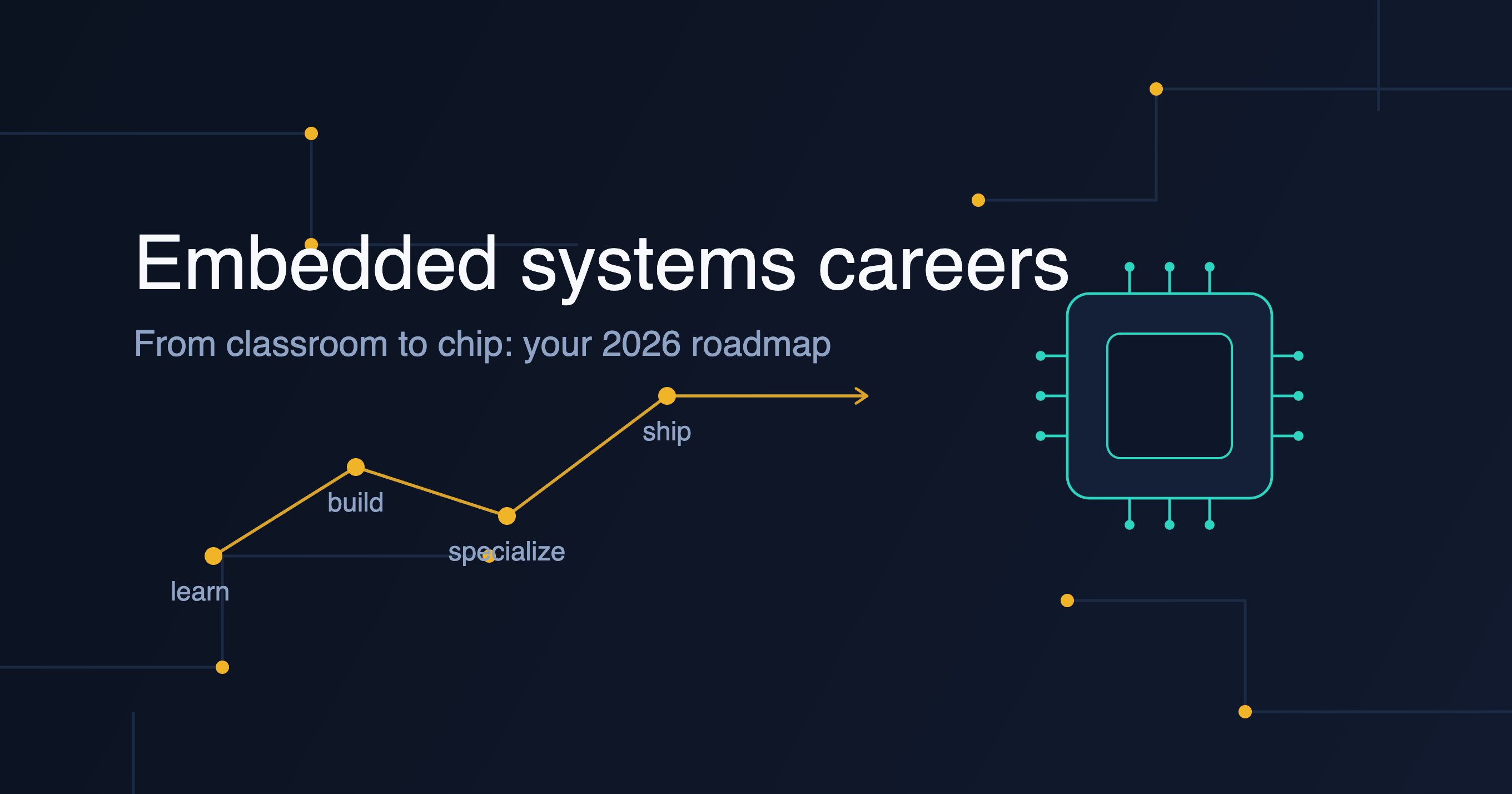
A Simple Roadmap: From Zero to Job-Ready
Stage 1 — Foundations (Month 1–2): Basic electronics, digital logic, and C programming fundamentals. Get comfortable with a breadboard and a multimeter before you touch a datasheet.
Stage 2 — Microcontrollers (Month 2–4): Start with Arduino or ESP32 for approachable, well-documented hardware. Build small projects — a temperature logger, a motor controller, a simple IoT device that sends data over Wi-Fi.
Stage 3 — Real-Time Systems (Month 4–6): Move to STM32 or similar industrial-grade microcontrollers. Learn RTOS concepts, interrupts, and timing constraints — this is where "hobby" projects start becoming "engineering."
Stage 4 — Specialization (Month 6–9): Pick a direction — automotive (CAN bus, AUTOSAR basics), embedded Linux, or edge AI (deploying lightweight ML models on-device). This is what differentiates you in interviews.
Stage 5 — Portfolio and Placement Prep (Month 9+): Build 2–3 solid, demoable projects, document them properly (a GitHub repo with a clear README goes a long way), and start applying with a portfolio instead of just a resume.
Who Should Actually Consider This Path?
- Engineering students (ECE, EEE, Instrumentation, or CS) who enjoyed the practical side of electronics more than pure theory.
- Diploma holders looking for a skill-based entry into core engineering roles without needing an advanced degree first.
- Working professionals in mechanical or IT fields looking to pivot into a specialized, harder-to-automate technical career.
- Anyone who likes seeing code do something physical — move a motor, blink a light, read a real sensor — rather than just render on a screen.
The Bottom Line
Embedded systems isn't a trendy career in the way "AI engineer" is trendy — there's no hype cycle around it. What it has instead is quiet, consistent, structural demand: every electric vehicle, every smart factory sensor, every wearable device, every piece of connected infrastructure needs someone who can make hardware and software work together reliably. That demand isn't going away — if anything, it's compounding as more of the physical world gets "smart."
The engineers who start building real, hands-on skills now — not just watching tutorials, but actually wiring a circuit and debugging a real-time failure — are the ones who'll be first in line for the roles this shift is creating.